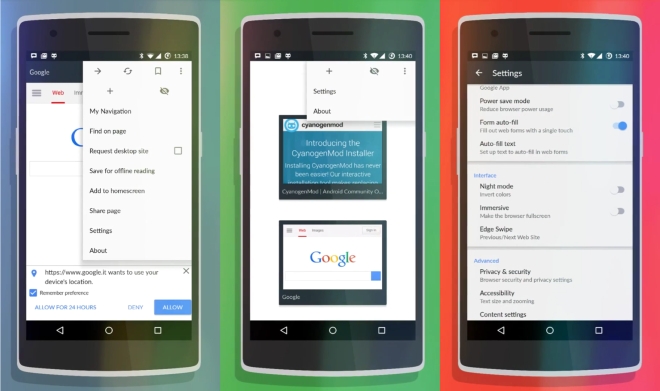
CyanogenMod has been working on a new browser, called Gello. The browser is based on Google’s open source web browser project and looks somewhat similar to Chrome, but is different enough.
Not much was revealed in the Google+ post announcing the browser but a short video gives a glimpse at the interface and some of the features of the upcoming browser, including edge swipe to go forward and backward, night and immersive modes, enhanced download manager, offline reading mode, and individual site settings to access features such as camera, microphone, and also ad blocking functionality. Read more »
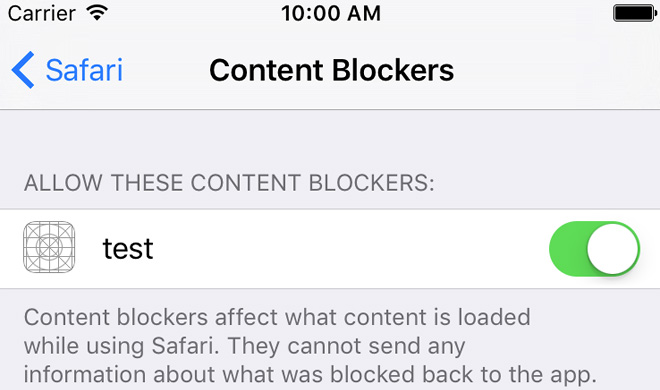
Your favorite ad blocker may soon land in Safari – both the iOS 9 and the Mac OS X El Capitan versions. The new functionality allows apps to give Safari rules about blocking cookies, images, other resources, pop-ups and other content.
This should enable everything from ad blocking to privacy add-ons to work natively on Apple gadgets. Read more »
Google has started rolling out a new feature for Chrome on Android that allows you to search from any web page with just a tap. Dubbed Touch to Search, the feature is similar to the Google Now on Tap feature that the company announced at its I/O developers’ conference last week.
“Since Chrome can see the page you’re searching from, it can give you more accurate search results. For example, just tapping on America on the page below shows a search about the movie Captain America: Civil War, not the country. Just slide up to see more information—news, cast, images and more,” the search giant said in a blog post. Read more »
Google has announced that it has worked with Adobe to introduce a new feature in its Chrome web browser that automatically pauses unnecessary Flash content running on the web page being viewed.
“When you’re on a webpage that runs Flash, we’ll intelligently pause content (like Flash animations) that aren’t central to the webpage, while keeping central content (like a video) playing without interruption,” the company said in a blog post, adding that the update significantly reduces power consumption. Read more »
The Edge variant of the next Samsung Galaxy Note phablet, which is said to be internally codenamed Project Noble, has been spotted on benchmarking website HTML5test. The website scores web browsers in their ability to properly load HTML5 elements.
The test was performed on the Samsung browser 3.2 installed on a Samsung ZenZero device running Android 5.1.1 – ZenZero is said to be the internal name of the Galaxy Note 5 Edge. The browser got 503 points, which is a great score – the best-faring currently available mobile browser Chrome 39 scores 493. Read more »
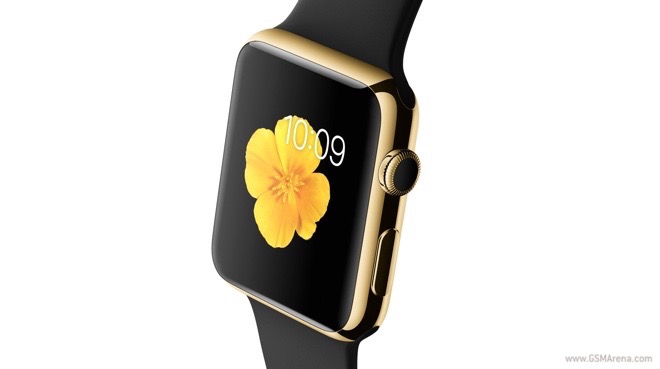
It looks like the Apple Watch can run a web browser if you hack it. The crafty developer Comex has enabled the feature after tinkering with Cupertino’s wearable device.
As you can imagine, browsing the worldwide web on the tiny screen of the Apple Watch is an exercise in frustration. Read more »
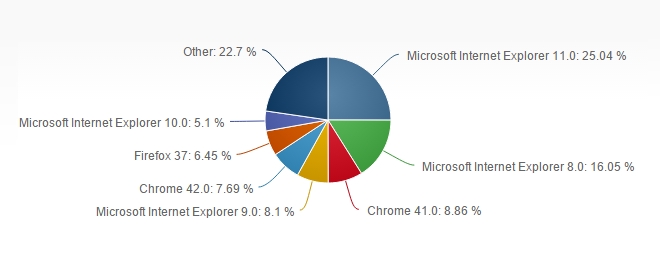
Microsoft’s Internet Explorer 11 is currently the leader in the browser market with 25.04% market share, according to Internet statistic firm Net Market Share, which has recently released its stats for the desktop web browser market for April 2015.
As clear from the pie chart shown above, IE 8.0 came in second with 16.05 % share, while Google’s Chrome web browser (version 41.0) captured the third spot with 8.86% market share. IE 9.0, Chrome 42.0, and Firefox 37 rounded up the top 5 with 8.10%, 7.69%, and 6.45% market share, respectively. Read more »
In yet another effort to protect users from phishing attacks, Google has launched a new extension for Chrome browser that the company claims protects their Google accounts. Dubbed Password Alert, the free, open-source extension is also available to Google for Work customers, including Google Apps and Drive for Work.
“The most effective phishing attacks can succeed 45 percent of the time, nearly 2 percent of messages to Gmail are designed to trick people into giving up their passwords, and various services across the web send millions upon millions of phishing emails, every day,” the Mountain View, California-based company said in a blog post. Read more »
On Android, Google’s Chrome Web browser has long had a Beta version in the Play Store for eager people to try. Yet until today the Dev channel releases that Chrome regularly gets on Windows, Mac OS X, and Linux did not have a correspondent for Android.
If you love living on the bleeding edge of browser development, then you’ll be happy to know that starting today you can try Chrome Dev for Android too. This is already up for grabs in the Play Store, but it seems geo-restricted for now, so you may not be able to download it depending on your location. Read more »
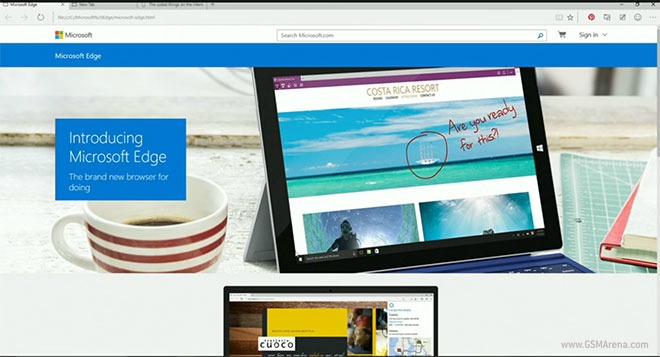
Today during its Build conference, Microsoft has finally announced what it’s going to call its new Web browser for Windows 10. This has been known so far as Project Spartan, but its official name will be Microsoft Edge.
Edge will be the default browser in Windows 10, although a version of Internet Explorer will also be in there just for compatibility’s sake. Read more »
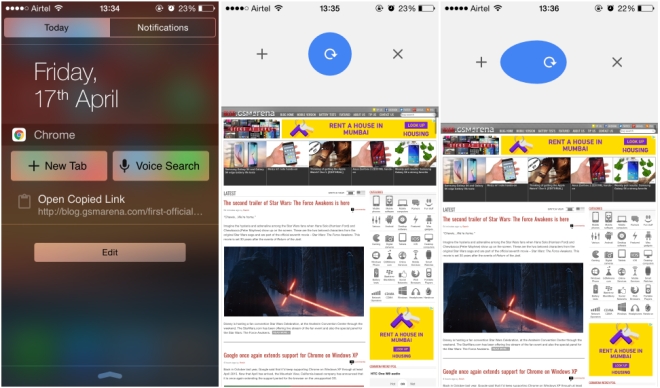
Chrome for iOS got a major update today that added several useful new feature. The first one is a new widget that sits in your Today view. The widget allows you to open a new Chrome tab or do a Google voice search right from the notification window. And if you happen to copy a URL from some other app, the URL will appear in the widget so one click will open it straight into Chrome.
Another addition is pull to refresh, which lets you refresh the web page by pulling down on it, which was first implemented in the Android version of the app. What wasn’t in the Android version, however, was that you can pull down and then slide your finger left to quickly open a new tab or right to close the current one, which is displayed with a neat little animation. Read more »
Back in October last year, Google said that it’d keep supporting Chrome on Windows XP through at least April 2015. Now that April has arrived, the Mountain View, California-based company has announced that it is once again extending the support period for the browser on the unsupported OS.
“We will continue to provide regular updates and security patches to Chrome on XP through the end of 2015,” said Chrome’s director of engineering Mark Larson in a blog post. He also encouraged XP users to update to a supported, secure operating system. Read more »
Google has really become meticulous in its updating habits, especially in the Android realm. Work is done quickly and rollouts are usually quite speedy and come in bulk, especially when an exciting new technology has to be delivered to users.
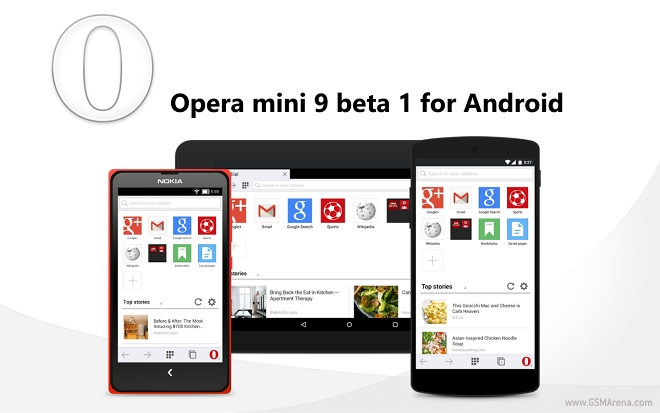
Yesterday, Opera marked its 10-year birthday by finally ushering Opera Mini 8 for Android out of beta. The app comes with a flashy new, material-inspired look and is still backwards compatible all the way back to Android 2.3 Gingerbread.
This move definitely didn’t go unnoticed, but, as it turns out, the team is already hard at work on the next major version on the mobile browser. The Play Store now features a brand new Opera Mini 9 Beta, already up for download by eager early adopters. It still doesn’t pop up in search results though, so here is a direct link. Read more »
Google has been experimenting with a new UI for the YouTube player. The UI has transparent player controls that show you the relevant buttons without blocking the video.
The UI is still in development and hasn’t been finalized yet. But if you want to give it a shot, there is a way. Read more »




 Oppo R1x battery life test
 Your verdict on Android M, iOS 9 and Watch OS 2.0
 Oppo R7 battery life test
 Lenovo A7000 Preview
 HTC One E9+ performance benchmarks